Wednesday, August 24, 2011

Update about text messaging

I was doing some cutting edge research on Wikipedia* when I found this article: Internet Linguistics.  I was trying to find a list of linguistics sub fields when this came up.  Those in the field of internet linguistics study new language styles that have arisen from use of the internet and related media (such as text messaging).  Internet linguistics could be used to improve media technology usability.  And it's fun to study how language is evolving in the new communication media.

This fit so well with my post on text messaging that I had to talk about it.  It was so exciting that it needed its own post.  Based on what I read in the article, this is a very new field.  I'm guessing that most of the research ideas I brainstormed are still up for grabs.

*I wasn't really doing cutting edge research on Wikipedia for those of you who are worried

Sunday, August 14, 2011

Some Cautions on Meeting a Linguist

If you've ever met a linguist (and I think most of my readers have met me) you don't need to worry about whether or not you're pronouncing words right or being grammatically correct or whatever.  It's not our business to pass judgement on others for the way they speak.  More likely, if you say something in an unusual or nonstandard way, the linguist will be thinking, "Wow!  That's fascinating!  I wonder how I can explain this deviation."  I know I'm certainly not perfect.  As I write this blog entry, little squiggly lines keep drawing my attention to the spelling mistakes I make as I type.

Also, I speak one language fluently.  I'm glad that the one language I speak fluently is used globally and is the language I'm most interested in.  If I suddenly found myself in Mexico City or Moscow I could get by though.  In the case of Moscow, I would probably know just enough to get back to the US Embassy.  Maybe if I wasn't studying linguistics, if I wasn't so well aware of how much more there is to Spanish and Russian, I would inflate my language abilities a bit more.  "What languages have you studied?" will get you a better answer from a linguist than "What languages do you know?"

Sometimes linguists are like language spies.  This has to do with what I was describing in the first paragraph.  When people find out they're talking to a linguist they get self conscious and don't talk as they normally would.  Therefore, linguists sometimes have to be sneaky.  There is a variety of ways in which linguists have tricked people into talking naturally, for research purposes.  I'm not going to reveal them to you, just in case.

Friday, July 29, 2011

Grammar Textbook Issues

I was in the School of Education department today when I noticed some language arts textbooks on the free book table.  So, of course, I stopped to look at them for just a minute.  I found them inadequate, woefully so.  I was reminded that one of my goals in life is to remake the primary school grammar textbooks so that they reflect all of the great syntax research that's been done in the last 50 years.  This, I feel, is a noble goal and I would like to explain why.

From what I can tell, the way we teach English grammar to elementary schoolers hasn't changed since I was in elementary school (I checked the dates on those textbooks in the school of ed.  and they were recently published).  I suspect it hasn't changed for much longer than that.  Now, to make an analogy, the modern science of molecular biology has its roots in the 1950s with the discovery of DNA structure.  A responsible school board would never choose a science textbook meant to cover biology that didn't, in some way, address the role of DNA.  I remember making a model of a cell in 5th grade, complete with DNA strands in the nucleus.  Yet, these discoveries are relatively recent.

To contrast, Chomsky's revolutionary book on syntax, Syntactic Structures, came out around the same time.  I have yet to see the impact of these discoveries on the grammar textbooks.

Here is an example of how far behind the textbooks are:

Most grammar textbooks would have students diagram a sentence like this:
The cat slept on the carpet.
A syntactician would diagram the sentence at least like this:
The cat slept on the carpet.

If not like this:
The cat slept on the carpet.
Okay, the second one might be a bit complex for grade school students, but the first syntax tree makes the point.  Using this method shows how the phrases work together in ways that the traditional sentence diagram doesn't.  The phrase structure is more transparent in this type of diagram.  Why aren't we teaching this way?  Why are we holding students back?

P.S. I made these trees from memory.  If any of my lingistics friends finds a mistake (especially with the second tree) please let me know so I can fix it.

Monday, July 11, 2011

Strunk/White

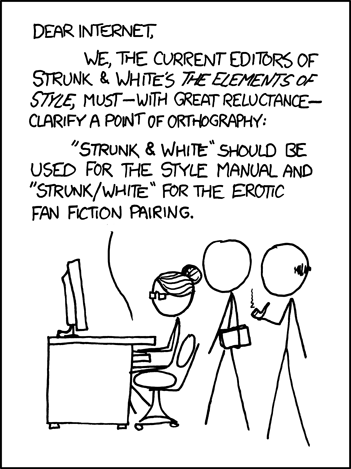
I love xkcd.  Here I was, in a writing slump.  Do I have things I could write about?  Sure, but I just didn't feel like it.  And then, with perfect timing, this comic is posted:
I see two things in this comic.  One, I find it really disturbing that someone would write a slash fic about two men who are most famous for writing (Strunk) and editing (White) a popular style manual.  I like to think of myself as a language geek, but that's going a bit far.

Second, I find it interesting that fan fiction pairings have their own naming conventions, two names separated by a forward slash.  Furthermore, such pairings are also known as slash pairings for the same reason (so named for the forward slash).  It's a good example of how language evolves to meet the needs of the speakers (or in this case, the typers).

Update: Someone did try to write Strunk/White slash fiction.  You can find it here: http://languagelog.ldc.upenn.edu/nll/?p=3260#more-3260.
I stopped reading quickly.  The weirdest thing is that this site is mostly contributed to by professional linguists. Good job guys, you are definitely more dedicated to being language geeks than I am.

Saturday, June 18, 2011

why text messages are fascinating ;)

Someday there should be an area of linguistics dedicated to text messages.  Or, there could be a slew of theses about text messaging.  It could be referred to as the time when everyone was studying text messages.  This may be going on already, but I haven't seen a linguistics paper on text messages yet and I'm years away from writing a doctoral thesis.

Anyway, hopefully after reading this post you will never see text messages the same way again.  Here is a list of interesting linguistic things about text messages:

-Different people have different texting styles.  Some always add emoticons (like the one in the title of this post).  Some use perfect standard American English grammar.  Some use a strange grammar that doesn't look like a grammar at all and yet has very methodical rules.*

-Even the people who start out with the perfect standard grammar will usually use more of the texting grammar as time goes on.

-Is there a texting grammar?

-Some people feel the need to open up conversations.  I know at least two people who preface their first text in a conversation with "hey girl" or "hey ladies."  I tend to jump right in.  Is there some kind of pattern to this?  Would people from a particular dialect group prefer one way over another?

-How does one end a conversation in texts?

-When is it inappropriate to call someone vs. text someone?

-"Text" can be a verb.

And this is why text messages are fascinating.

*Linguists define grammar as the set of rules which govern the structure of a language.  It encompasses so much more than what was in the elementary school grammar book.  To fully explain the concept of grammar would take another post.  For the sake of this one, I need to leave you with this concept:  all natural human language is governed by grammar rules.  This means that even something like a rural dialect has structural rules which would be called a grammar.  Therefore it would be interesting to uncover the grammar underlying text messaging when it deviates from the grammar of standard American English.  If anyone would like me to expand on this concept of grammar, please let me know.  I will try to make it less tedious and technical than this explanation.

Monday, June 6, 2011

Pygmalion

I meant to post this weekend, but I found myself in an epic battle with my computer on Saturday over its functionality.  I eventually won, but there was much loss on both sides.

Anyway, as I waited for my computer to run diagnostics and fail to boot yet again, I read all of the play Pygmalion by Bernard Shaw.  For those of you who aren't familiar, it's a play about a professor of phonetics, Higgins, who decides to pass off a lower class Cockney girl, Eliza Doolittle, as a duchess by teaching her how to speak like one.  If this sounds familiar, you may have seen My Fair Lady, the musical based on the original play. It was made into a movie starring Audrey Hepburn as Eliza.

The play was less about linguistics than I thought.  The setup of a phonetics professor teaching a Cockney girl to speak as if she were upper class is a vehicle for a critique of the upper class which Eliza is striving to imitate.  It does, however, highlight the way our language is not always the thing that most defines us.

In a previous post, I talked about the way people subconsciously judge people by the way they speak.  The linguistics community tends to make much of this connection.  While the way we speak is one of the main ways we are judged, it is not always the most important way.  Eliza offers us a counterexample.  Higgins can teach her how to say vowels and consonants like a duchess; he can even tell her which phrases mark her as a member of the lower class.  However, it is Pickering (an expert in Indian dialects and a friend of Higgins) who really teaches Eliza to be a duchess, and she says as much in the final act.  Pickering teaches Eliza self-respect by treating her like a duchess from the first rather than a low class woman.  In the final test, it is that air of self-respect that truly marks Eliza as upper class, not the phonetics lessons.

Saturday, May 28, 2011

Word of the Day

I subscribed to Merriam-Webster's word-of-the-day service a few months ago to improve my vocabulary.  I'll be taking the GRE in August and every bit of vocabulary practice helps.

Merriam-Webster has not been very helpful in improving my vocabulary.  It has been much more entertaining.

Very few of the words are useful for vocabulary building.  Most of the words are either obscure or common.  I've managed to build up a fairly large vocabulary, so common is a relative term here.  The definitions are what one should expect from a professional dictionary.  They are succinct and helpful.  The best part is the etymology (or word history).  I think they're informative and funny, and that's not just because I'm as much of a language geek as the lexicographers.

Appropriately, the word of the day for today is lexicographer, or someone who writes dictionaries.  I used to think writing a dictionary would be a boring job.  That was back in the day when I scribbled poems all over brightly colored notebooks.  Now I think being a lexicographer would be fascinating.  I could pour through modern literature and the internet, searching for new words and new uses of words.  I could find out where those words come from, digging deeper into the ever-evolving English language.

Anyway, I would recommend Merriam-Webster's word of the day to any lover of words.